Category

Aesthetic medicine blog

Allergy to cosmetics, intolerant skin and hypoallergenic creams

alergia-cosmeticos-pieles-intolerantes-1010495-1301957-jpg-4986729

1. Is there an allergy to cosmetics?

The "allergy" to cosmetics exists. I put “allergy” in quotes because it is a general definition, which we dermatologists refer to as contact dermatitis or eczema. the Contact dermatitis occurs when a substance "in contact" with the skin inflames it. This inflammation can occur in two ways, one by contact in excess of an irritating substance, later we call it "irritant" (such as: bleach, usual hand washing, cold, excessive heat, etc.) or because the patient has a proper reaction to the agent that comes into contact with the skin, in this circumstance an allergy itself. The difference is that any irritant in sufficient quantity can irritate any skin, however, in allergic contact dermatitis the patient "defines" his own immune reaction.

Once located, contact dermatitis to cosmetics represents approximately 2 to 4% of visits to the dermatologist, it is more common in women and in the The 60% of the cases are truly "allergic" (and non-irritating) (1). The estimated prevalence in the general population is lower, calculating around 0.01 to 0.03% of the population with allergy to cosmetics. This prevalence is estimated, since it is estimated that only 15 to 30% of the patients go to the dermatologist (2), and that the majority avoid the “suspicious” product without going to the doctor.

Therefore, it is a reason for consultation that exists, is unusual and has an impact on the quality of life of patients (1,2).

2. What happens to my skin if I am allergic to creams?

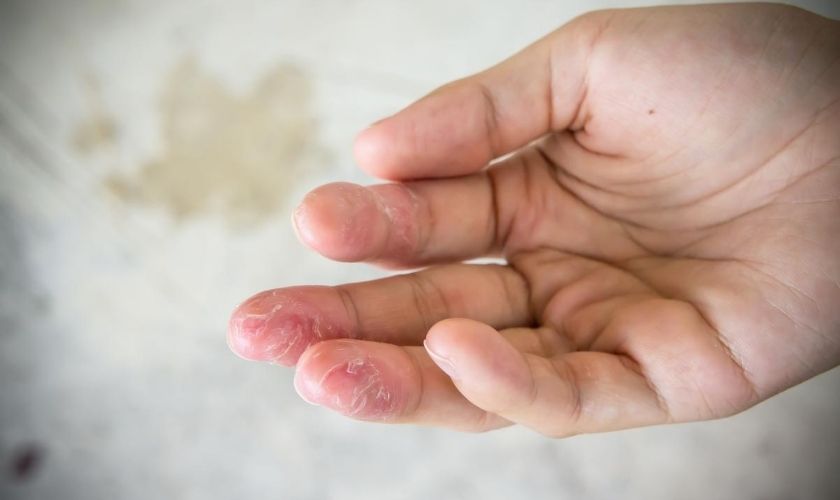
What arises is the appearance of eczema (dermatitis), a irritation of the skin in the product contact area. Eczema can manifest acutely, with exudation and vesicles or chronically, with peeling and redness of the skin. Allergic eczema, once triggered, can become generalized and affect distant areas from where it originated, in the form of papules, vesicles and dermatitis in other locations.

3. What cosmetics can cause allergies?

Any product on the skin is capable of producing allergies. The most frequent are moisturizers and gels or soaps to clean the skin. Then we also find the tints and hairdressing products and other cosmetics such as nail polish or sunscreen (1).

Most cream allergies occur on the face (20%) and hands (20%), with generalized or leg forms less common. Inside the face, the location in the eyelids stands out, an area of the face with thin skin in which we apply many cosmetics, and which alone represents 10% of the total (2).

Example of allergy to cosmetics: eyelid dermatitis.

4. What components of cosmetics cause allergies?

the fragrances are the most common cause of allergy to cosmetics, followed by preservatives and hair dyes (1,2). The cosmetics most related to allergy to fragrances are perfumes. To prevent the degradation of cosmetics, preservatives are added to their composition, which include parabens, the formaldehyde and the isothiazolinones (Kathon) to which the patient can be sensitized.

5. Should I avoid ingredients that cause allergies? Should I use creams without parabens?

Always, if you are sensitized, it is not necessary if you are not. Parabens are the most used preservative in cosmetic products, it is present in practically all of them. Considering its wide use, its sensitization ability is low (1%), even sensitized (allergic) patients tolerate its application in cosmetic creams for daily use in what is called “the paraben paradox” (1).

6. How can I know if I have an allergy to cosmetics?

After a detailed dermatologic history and consultation evaluation, the dermatologist may consider performing the study of allergic dermatitis through “contact tests” or “patch tests”. It involves placing patches with the allergens on the patient's back and observing the reaction that appears on the skin at 48 and 72 hours.

By agreement of experts, in each country the most frequent allergens in the population are selected for the study of contact dermatitis, in what is called "standard battery". Approximately half of the reactions to creams or cosmetics are detected by this battery (1) which includes the perfume mixture Kathon (methylchloroisothiazolinone / isothiazolinone) which is a preservative and paraphenylenediamine (PPD) which is a component of hair dyes.

7. If I use creams with natural ingredients, am I less likely to develop an allergy?

Not, and perhaps even more so, since patients with allergic dermatitis to cosmetics have a high prevalence of sensitization to plant extracts. Tea tree, for example, is a common sensitizer. The main problem is that these ingredients are not well classified on cream labels and their study and identification is more difficult. For this reason, patients with allergies to cosmetics are advised to avoid creams or cosmetics with plant extracts (1).

8. Can sunscreen give me allergies?

YesLike any other cosmetic. Apart from the usual components of cosmetics in sunscreen creams, we find compounds used for this purpose that are capable of causing allergies (oxybenzone, dibenzolmethanes).

We also find the sum of the sun exposure of the contacted area, in which the cream is applied, and the opportunity for a joint effect in what we call "photocontact" (light photo, allergic contact dermatitis). The famous PABA (para-aminobenzoic acid) is practically no longer present in sunscreens on the market.

On the other hand, it is essential to point out that with physical or mineral filters such as zinc oxide or titanium dioxide, no allergies have been described. So, if we want safety on sensitive skin, we will use this type of cream to protect us from the sun (1).

9. The term hypoallergenic creams, what do you mean?

A product to be considered hypoallergenic is a product that you have few chances to cause skin allergy and must (3):

• Not contain any ingredient that has caused allergies in the 1% of the population in the last 5 years and with at least 1000 patients studied.

• Do not contain ingredients for which there is no published data in the last 5 years.

In the current market, approximately 90% of moisturizing creams have at least one contactant or a component capable of causing skin allergy and the current regulation of cosmetics on the market in this regard is limited (4). The term "hypoallergenic" in a cream can be confusedEven creams with this term designed for sensitive or baby skin can contain perfumes or more contaminants that are not present in others or in pure petroleum jelly (5).

The American Contact Dermatitis Association (6) advises patients not to rely on the term “hypoallergenic” and revision the components of the products you use, especially if you are allergic to cosmetics.

Hypoallergenic creams: woman who controls the components.

10. Are there really intolerant skins?

Yes, there are skins that do not tolerate creams and cosmetic products. As we have seen throughout this text, allergy to cosmetics exists and is not so common in the population. In sensitive skin, which does not tolerate creams and hygiene products, we prescribe suitable products, even when the characteristics of the skin are decisive. The market offers complete lines suitable for this type of skin, which are labeled as "sensitive skin", "intolerant skin", "skin prone to redness", "irritable skin", etc.

References

1. González-Muñoz P, Conde-Salazar L, Vañò-Galván S. Allergic contact dermatitis to cosmetics. Actas Derm Sifiliogr 2014; 105; 822-832.

2. Dinkloh A, Worm M, Geier J, et al. Contact sisitization in patients with suspected contact intolerance: results of the IVDK 2006-2011. J Eur Acad Dermatol 2015; 29: 1071-1081.

3. Zirwas M. Trying to establish “hypoallergenic”. JAMA Dermatol 2017; 153: 1093-1094.

4. Hamman C, Thyssen. Allergen concerns and popular skin care products. JAMA Dermatol 2018; 154: 114-115

5. Harview C, Hsiao J. Allergen concerns and popular skin care products. JAMA Dermatol 2018; 154: 114.

6. Verallo-Rowell. The validated hypoallergenic cosmetics classification system: its 30-year evolution and effect on the prevalence of cosmetic reactions. dermatitis 2011; 22: 80-97.

7. Xu S, Kwa M, Lohman M et al. Consumer preferences, product characteristics, and potentially allergenic ingredients in best-selling moisturizers. JAMA Dermatol 2017; 153: 1099-1105.

8. Chou M, Mikhaylov D, Lazic Strugar. Moisturisers: a basis for comparison between allergens and economic value. Dermatitis 2018; 29: 339-244.

I invite you to share this post with your friends and loved ones who you think may be interested or have questions about allergies to cosmetics, intolerant skin and hypoallergenic creams.

You may also be interested in:

Cosmética de manicura y uñas: 10 consejos del dermatólogo

salon-cosmetica-unas-dermatologia-1900237-9184462-jpg-8865561

En este post hago un repaso de la manicura y cosmética de uñas desde el punto de vista del dermatólogo e indico 10 consejos para alcanzar mejores resultados y evitar o arreglar diferentes problemas que puedan surgir.

Llevar las uñas pintadas es un símbolo de estar arreglado, de belleza y atractivo. El mercado de la cosmética y la estética de uñas está prácticamente reservado a los mujeres con un incremento en el espectro de productos y salones dedicados a la estética de uñas.

Los productos que se usan para el cuidado de las uñas son seguros y no disponen por qué tener más complicaciones que los que se usan para el cuerpo o el cabello. A pesar de todo, la anatomía y función de las uñas es peculiar y, al mismo tiempo, el dermatólogo no siempre es consciente de la procedimientos realizados en las uñas con fines cosméticos.

1. Tratamientos médicos para las uñas

El desarrollo de líneas cosméticas para uñas posibilita, en primer lugar, ofrecer tratamientos tópicos para sus alteraciones. los esmaltes Las formas de laca de uñas posibilitan, en sus formas solubles en agua, hidratar la uña (como un humectante) y en su forma tradicional de esmalte, con color, para camuflar los defectos de las uñas.

Ejemplos de estos defectos son puntuación uña longitudinal que aparece con la edad o la aparición de spots. Algunas dermatosis disponen afectación ungueal, la psoriasis es la más habitual, y además la encontramos en dermatitis crónica o liquen. Las lacas de uñas nos posibilitan tratarlas y además disimularlas.

Las uñas artificiales se pueden usar para disfrazar los trastornos congénitos de las uñas (cambios de forma) y además para evitar morderse las uñas. En este último, en mi experiencia, son muy efectivos.

2. Manicura

La manicura, o su versión en los pies, la pedicura, se trata de sumergir las uñas en agua tibia y después cortarlas, de esta dinámica evita que la uña se parta en capas. Las cutículas, además blandas, se mueven hacia arriba para poder pintar bien toda la lámina y se lima la placa ungueal para, en teoría, favorecer la penetración del esmalte.

Sumerja las uñas en agua Cortarlos perpendicularmente es útil para evitar que las uñas, sobre todo las quebradizas, se agrieten por fuera. A pesar de todo, cutículas Disponen una función, que es proteger la raíz de la uña de los ataques, por lo que sería mejor no manipularlos.

No hace falta limar las uñas para ponerles laca de color y no aumenta su penetración (1).

Anatomía de las uñas

3. Esmaltes y lacas de uñas

Para pintar uñasEn casa o en los salones, primero puede aplicar una o dos capas de base y después una o dos capas del color, dejando que se seque entre ellas. Las lacas de uñas están compuestas por resinas, disolventes, plastificantes y agentes estabilizadores del color (1-3). Su composición está regulada en Europa, y es viable, aún cuando no es habitual, que aparezcan allergy a cualquiera de los compuestos de esmalte de uñas.

Es curioso observar cómo se manifiesta la alergia a algún componente del esmalte de uñas desde la distancia, en zonas sensibles de la piel, como los párpados o el cuello, cuando el paciente se toca con las uñas pintadas. Como consejo, en el eccema de párpados, pregunte al paciente si se pinta las uñas.

4. Clavos y puntas de plástico

Son puntas preformadas y se usan como método casero de alargamiento de uñas dado que se aplican con una simple manicura (1). Se aplican con un pegamento de cianoacrilato en la placa de la uña y después se le da la forma deseada. Sensibilización sobre las colas cianoacrilatos No está claro y si este tipo de pegamento ha descrito trastornos respiratorios irritantes como asma o rinitis.

Por otra parte, estas puntas son rígidas y es más probable que su uso tire de la uña y la desprenderse del dedo (la cama) en su parte más alejada (distal), en un fenómeno que llamamos onycholysis. Las uñas desprendidas son más susceptibles a ser infectadas por cándida y pseudomonas (3), por lo que se debe advertir a los pacientes con uñas postizas que la uña no destaques mucho de las yemas de los dedos.

5. Uñas acrílicas, uñas de gel

Los acrílicos se aplican a la placa de la uña en forma de solución o polvo diluido y son muy resistentes. Por lo general, la placa de la uña se deshidrata primero con alcohol isopropílico. Los acrílicos se pueden mezclar con diferentes componentes para impulsar sus propiedades.

La mezcla acrílica se endurece rápidamente posteriormente de aplicarse a la placa de la uña y se le da forma y después se pinta con laca. A medida que la uña crece, se torna a aplicar en la raíz. Las uñas de gel son una variante que se fija con luz ultravioleta.

Los componentes de los acrilatos pueden sensibilizar y causar dermatitis de contacto (alergia). En casos de altas concentraciones, el metacrilato de metilo es capaz de producir síntomas locales como hormigueo e hinchazón en la zona, por lo que la concentración permitida está regulada por los organismos competentes (1-3).

No es raro que con un uso prolongado veamos en la consulta de dermatología infecciones bacterianas o micóticas derivado de la oclusión crónica de la placa de la uña. La tracción crónica de la uña además puede provocar desprendimiento parcial, deterioro del crecimiento y nuevas infecciones en el área de apoyo de la sábana en la planta del pie. La infección que surge con mayor frecuencia es por una levadura, Candida albicans, que se asocia con la humedad y la oclusión (2).

6. Geles y adhesivos para uñas tratados con luz ultravioleta A (UVA)

En los procedimientos anteriores, se puede utilizar luz ultravioleta para fomentar la imprimación de los compuestos en la placa de la uña. Existe un debate sobre si esta exposición en manicura es capaz de aumentar el riesgo de cáncer de piel, aún cuando los estudios más recientes sugieren que no lo es (1,2).

Para una exposición regular a las lámparas UVA se recomienda proteger la piel y exponer solo las uñas y además use protección para los ojos. Se debe tener precaución si se toman medicamentos que pueden sensibilizar a la luz y afectar las uñas, como las uñas. tetraciclinas (1,2,4).

7. Quitaesmalte de uñas

Un quitaesmalte es un producto cosmético que se usa para borrar el esmalte de uñas.

Son seguros y su composición está regulada. Contienen acetona, acetato de etilo o metilcetona. Su uso en exceso puede producir deshidración de la piel y si se mezclan con perfumes o fragancias, dar allergy siendo estos una viable causa.

Manicura, cosmética de uñas y dermatología.

8. Seguridad sanitaria en los salones de uñas.

Los archivos y utensilios de metal utilizados en los salones de manicura deben esterilizado entre cliente y cliente. Estos utensilios pueden ser una vía de transmisión de bacterias, hongos y verrugas virales (1). Las micobacterias atípicas además pueden aparecer en baños calientes para manicuras y pedicuras si no se limpian adecuadamente, provocando infections en la piel.

9. Uñas artificiales en empleados sanitarios

Las uñas artificiales pueden albergar patógenos como hongos, levaduras (cándida) y bacterias (Pseudomonas, Klebsiella). Estos patógenos pueden infectar a pacientes quirúrgicos, inmunosuprimidos y débiles. Es por ello que es recomendable llevarlos corto y sin adornos.

10. Medición de oxígeno en sangre.

Use uñas pintadas alterar la medida de oxígeno en la sangre a través de oxímetro de pulso, una abrazadera que se coloca en el dedo. De esta manera, siempre se recomienda borrar el esmalte de uñas antes de utilizar o ir a un quirófano. Un estudio reciente encontró que utilizar uñas pintadas aumenta falsamente los niveles de oxígeno en sangre, lo que respalda la necesidad de borrar siempre el esmalte de uñas (5).

Podemos concluir que lo que vemos con mayor frecuencia en la consulta dermatológica son traumas derivados de la manipulación de uñas e infecciones fúngicas.

Se siguieron referencias para elaborar un post sobre manicura y cosmética de uñas desde el punto de vista de la dermatología.

1. Jefferson J, Rich P. Actualización sobre cosméticos para uñas. Dermatol Ther. 2012; 25 (6): 481-490.

2. Dinani N, George S. Cosméticos de uñas: una perspectiva dermatológica. Clin Exp Dermatol. 2019; 44 (6): 599-605. doi: 10.1111 / ced.13929

3. Jefferson J, Rich P. Actualización sobre cosméticos para uñas. Dermatol Ther. 2012; 25 (6): 481-490. doi: 10.1111 / j.1529-8019.2012.01543.x

4. Wang JV, Korta DZ, Zachary CB. Manicuras en gel y luz ultravioleta A: Un llamado a la educación del paciente. Dermatol en línea J. 2018; 24 (3): 13030 / qt5hx4g5v4. Difundido el 15 de marzo de 2018.

5. Yek JLJ, Abdullah HR, Goh JPS, Chan YW. Los efectos de la manicura en gel sobre la oximetría de pulso. Singapur Med J. 2019; 60 (8): 432-435. doi: 10.11622 / smedj.2019031

Best self-tanners and resolution of frequent doubts

mejores-autobronceadores-antes-despues-8115549-7118932-jpg-9235925

Find out which are the best self-tanners and the resolution of frequent doubts about their use, safety and impact.

With the end of summer, the golden tone of the skin is lost, but can we do something to preserve it or have it safe all year round? It's essential to remember that no dermatologist, myself included, is going to recommend sunbathing. In the following text we review the products capable of achieving a tanned skin color avoiding sun exposure. It is a growing market.

1. What are the best self-tanners, what do they wear and how do they work?

Practically all self-tanners on the market have as active principle the Dihydroxyacetone, hereinafter DHA (1,2). DHA can be combined with other ingredients capable of inducing pigmentation such as:

  • erythrulose: a derivative of sugar (famous ¨sugar cane¨ tanning).
  • Tyrosine derivatives: capable of inducing pigmentation in the skin.
  • Naphthoquinone: an orange pigment obtained from Henna.

These substances induce skin pigmentation, but it is not a tan. DHA darkens the skin by reacting with amines present in the stratum corneum (the most superficial part of the skin) and achieves more coloration when used in higher concentrations. Erythrulose acts in an equivalent way and even when it has a lower color intensity than DHA, when formulated together, produce a More homogeneous and long-lasting tan. Tyrosine derivatives are accelerators of the natural pigmentation of melanin in the skin.

The main limitation of DHA is that it is unstable and thermolabile. For this reason, we will find it in lipophilic emulsions of basic PH, in concentrations from 3 to 20%, which try to ensure a homogeneous distribution of the active ingredient in the skin (1).

Erythrulose is much more stable and easier to formulate, however, as we have discussed, it is less potent than DHA.

2. Do self-tanners protect from the sun?

Interestingly, dihydroxyacetone (DHA) in high doses darkens the stratum corneum and provides the identical to a sun protection factor of 2 or 3. However, this contribution is entirely insufficient be considered a protector of ultraviolet radiation (1).

3. Are self-tanners safe?

Toxicity studies conducted with DHA have shown that it is devoid of both applied to the skin and systemic (inhaled) toxicity. Is contemplated safe for use in humans at concentrations below 10%, and this is the concentration limit set by European law (1).

Contact dermatitis or "allergy" to DHA is described in the literature, however, it occurs in the form of anecdotal or rare cases. Basically it can be considered that there is such an opportunity.

4. How to apply self-tanners?

In practice it is preferable to apply repeatedly a product less concentrated than once a highly concentrated product. In this way, a more uniform coloration is developed that is more reminiscent of a natural tan. The DHA application does not achieve immediate coloration, but it takes two to six hours to start to appear (1,2).

Woman applying self tanner

5. Tanning pills? Are they good for something?

They are food complexes based on carotenes and other carotenoids, lycopenes, vitamins and antioxidants. These are yellow-orange or red fat-soluble plant pigments that accumulate in subcutaneous fat, giving the skin a yellowish tint. Provides a healthy glow and they are also antioxidants and protect from sun damage and free radicals (aging). However, in isolation, they do not achieve more "color" than self-tanning creams (1).

6. What is the use of self-tanners in dermatology?

Self-tanners can be used to camouflage or hide lighter areas of skin. In scars or hypopigmented spots. Its use has been shown as an especially effective treatment alternative for vitiligo in children.

7. Could the widespread use of self-tanning creams in the population prevent skin cancer?

Self-tanning creams are safe and harmless to the skin, especially when compared to sunbathing to tan.

In a study of 250 women, awareness was raised about the use of self-tanners as an option to sun exposure. In the short term, there was a reduction in sunburn (associated with skin cancer) and increased awareness of other sun protection measures, such as clothing (5). However, other studies find the opposite, and that is that the use of self-tanners is also associated with the search for a brown appearance of the skin and the use of ultraviolet cabins and the performance of outdoor activities (4). Therefore, it is not clear.

There are no long-term studies on the use of self-tanners, but we already know about them, reduce solar radiation in our skin decreases the chance of having skin cancer.

I hope you find it useful and I take this opportunity to remind you that the best cosmetic that I can recommend is the use of sunscreen.

References

1. Martini MC. Self-tanning and artificial tanning products [Self-tanning and sunless tanning products]. Ann Dermatol Venereol. 2017; 144: 638-644.

two. Draelos ZD. Self-tanning lotions: are they a healthy way to tan? I'm J Clin Dermatol. 2002; 3: 317-8.

3. Zokaie S, Singh S, Wakelin SH. Allergic contact dermatitis caused by dihydroxyacetone: optimal concentration and vehicle for patch testing. Contact dermatitis. 2011; 64: 291-2.

Four. Paul CL, Bryant J, Turon H, Brozek I, Noble N, Zucca A. A narrative review of the potential for self-tanning products to replace solaria use among people who want a tanned appearance. Photodermatol Photoimmunol Photomed. 2014; 30: 160-6.

5. Pagoto SL, Schneider KL, Oleski J, Bodenlos JS, Ma Y. The sunless study: a randomized beachside trial of a skin cancer prevention intervention promoting sunless tanning. Arch Dermatol. 2010; 146: 979-84.

Isotretinoína en dosis bajas en el tratamiento del acné

isotretinoina-dosis-bajas-acne-12-2206617-6953835-jpg-8555896

Isotretinoína (Roacuan) En dosis bajas para el tratamiento del acné se recomienda por sus menores efectos secundarios, la oportunidad de combinarse con diversos tratamientos y por ser rentable.

La isotretinoína oral, el famoso “roacutan”, es el tratamiento más eficaz para el acné moderado y severo. Es sobre todo esencial como tratamiento para las alternativas para acné que dejan cicatrices.

Es un tratamiento seguro y bien tolerado, pese a su mala fama sin fundamento científico. Para su prescripción, es recomendable realizar análisis de seguimiento del paciente. Sus efectos secundarios dependen de la dosis, e incluyen la sensibilidad al sol y la sequedad de la piel y las mucosas como fundamentales.

Durante el tratamiento, se debe controlar la función hepática con análisis de sangre y se debe evitar el embarazo en mujeres en edad fértil hasta un mes posteriormente de concluido el tratamiento.

Los efectos colaterales de la isotretinoína oral dependen de la dosis, por lo que al reducir esa dosis, pueden reducirse inclusive con resultados finales comparables a las dosis completas o habituales.

1. ¿Qué son las dosis bajas de isotretinoína o “roacuan”? ¿Cómo se realiza un régimen de isotretinoína en dosis bajas?

Hay varias alternativas para publicitar isotretinoína por debajo de las dosis habituales. A modo de ejemplo, se pueden prescribir 0,5 mg / kg / peso y día una semana al mes durante 6 meses, o 5 mg al día durante 6 meses (1).

Además podemos tomar como referencia la dosis estándar, que es de 0,5 a 1 mg / kg / día durante 4 meses (hasta acumular 120 a 140 mg / kg / día), y dividir esa dosis aproximadamente entre 4 o menos (1,2 ).

Cuando utilizamos dosis de isotretinoína oral de 0,1 a 0,3 mg / kg / día, es recomendable prolongar el tratamiento durante 6 meses (1). Otra recomendación generalizada en la literatura es mantenerla hasta uno o dos meses posteriormente de que se resuelva el acné (2,3).

Clasificación de las dosis de isotretinoína

  • Dosis baja: 0,1 mg / kg / día
  • Dosis media: 0,5 mg / kg / día
  • Dosis altas: 1 mg / kg / día

2. Y posteriormente, ¿cuál es la microdosis o la minidosis de isotretinoína?

Es una forma de gestionar isotretinoína o “roacutan” en el acné adulto para evitar recurrencias posteriormente del tratamiento.

Consiste en gestionar una dosis baja o intermedia uno o dos días a la semana posteriormente de culminar el tratamiento durante 6 a 24 meses (3).

Siempre es esencial recordar a las pacientes en edad fértil que, aún cuando disminuir la dosis disminuye los efectos secundarios de la isotretinoína, esto no ocurre con el riesgo de dañar al bebé si quedan embarazadas durante el tratamiento. Hay que insistir en que nunca debe permanecer embarazada tomando isotretinoína, en ningún caso.

3. ¿Se obtienen los mismos resultados con isotretinoína oral en dosis altas que en dosis bajas?

Se obtienen resultados similares en eficacia (1-3), no obstante, la oportunidad de recurrencia, dicho de otra forma, de que el acné vuelva a aparecer, es mayor cuando se usan dosis bajas de isotretinoína. Esta tasa de recurrencia es aproximadamente del 35% de los casos (1). A pesar de todo, parece curioso que las diferencias de recurrencia entre el tratamiento estándar y el de dosis baja no sean estadísticamente significativas (35% vs 22%) (1,3,4).

Isotretinoína: estructura molecular.

4. ¿Se pueden tratar todos los tipos de acné con isotretinoína en dosis bajas?

Los estudios comentan que sí, inclusive las formas más graves de acné se pueden controlar con buenos resultados en dosis bajas (1,3).

Es por ello que tal vez lo mejor sea adaptarse al paciente, puesto que el uso de dosis bajas puede prolongar el tratamiento en formas graves de acné, aún cuando esto no ha sido probado (1). Lo que sí sabemos es que, en general, las formas más graves de acné necesitan más dosis acumuladas de isotretinoína para resolverse (2,3).

Considero a los pacientes con acné leve a moderado, que no responden a los tratamientos con cremas o antibióticos orales y con cicatrices leves, sobre todo buenos candidatos.

5. ¿Cuál es el principal beneficio de tomar isotretinoína oral en dosis bajas para el acné?

Hay varios, creo que si tuviera que seleccionar uno sería el mejor tolerancia para el paciente, dicho de otra forma, la oportunidad de vivir prácticamente una vida “normal” o su vida frecuente.

Aun así, si puede aparecer algún efecto colateral, aún cuando de mucha menor intensidad, el más habitual es la sequedad de labios o queilitis, presente hasta en un 40% de los pacientes de los estudios.

Otra gran utilidad es la oportunidad de usar concomitantemente otros tratamientos, que no se puede usar cuando se usan dosis estándar. Estos tratamientos disponen como objetivo mejorar la cicatrización y son retinoides tópicos, ácidos en diferentes concentraciones, peelings y láseres. Es es por ello que que esta dinámica de fijar la isotretinoína es muy útil en el acné moderado-severo y con cicatrices.

6. ¿Cuál es el principal inconveniente de tomar isotretinoína oral en dosis bajas para el acné?

En la mayoría de los estudios realizados con este régimen de tratamiento se encuentran mayores porcentajes de recurrencia del acné meses o años posteriormente de culminar el tratamiento, y en algunos llegan hasta el 52% (1). A pesar de todo, parece que esta diferencia no es estadísticamente significativa (3). La necesidad de dosis más acumulativas de isotretinoína oral en formas más graves de acné (1-3), hace que sea lógico pensar que necesitarían tratamientos más largos a dosis bajas.

7. ¿Tengo que hacerme las pruebas de control del mismo modo que si tomara isotretinoína en dosis altas?

La monitorización clásica del tratamiento “roacuan” en un paciente sano incluye hemograma, perfil hepático y lípidos antes y dos meses posteriormente de iniciar el tratamiento. Se puede agregar GGT para examinar el daño hepático y la CPK en pacientes físicamente activos (2). El tratamiento con isotretinoína en dosis bajas reduce los efectos secundarios del acné y la monitorización analítica Puede relajarse (2,3), no obstante, el dermatólogo valorará las pruebas indispensables a realizar en cada contexto.

8. ¿Existe algún factor que pueda predisponer a la recurrencia del acné cuando se trata con isotretinoína en dosis bajas?

Sí, existen algunos factores que están relacionados con un incremento en las tasas de recurrencia del acné y son los siguientes (1,3):

  • Edad joven en el momento del tratamiento.
  • Antecedentes familiares de acné.
  • Acné preadolescente.
  • Acné con afectación extensa, más allá del rostro.
  • Genero femenino
  • Sindrome de Ovario poliquistico
Isotretinoína en dosis bajas en el tratamiento del acné

9. ¿Existe alguna manera de prevenir la recurrencia de los tratamientos para el acné con isotretinoína en dosis bajas?

Hay algunos estudios que encuentran tasas de recurrencia más bajas cuando la isotretinoína se combina with a antibiótico macrólido, como azitromicina (1). La combinación con corticosteroides orales reduce la inflamación del acné, reduce los efectos secundarios pero no cambia la tasa de recurrencia posteriormente del tratamiento (1). Parece que las dietas ricas en vitaminas pueden reducir la recurrencia posteriormente del tratamiento del acné con isotretinoína (2,3).

10. ¿Y por qué lo uso?

Me posibilita un trato mucho más amistoso con los pacientes y que pueden hacer que la “vida” sea más normal. interfiere menos con su vida diaria.

Por otra parte, la piel adquiere mejor estilo reduciendo la sequedad con una dosis menor, para que el paciente se vea “guapo” antes y le dé satisfacción.

Además debido a que me posibilita relajar los controles analítica, siempre importante, y ahora más en tiempos de coronavirus, puesto que reduce los desplazamientos de pacientes.

Las dosis bajas de isotretinoína me posibilitan relajar la hidratación que el paciente requiere, y se me abre una variedad de productos temas que no pude usar en dosis completas y que me posibilitan trabajar en la cicatrización y calidad de la piel.

Cuando uso isotretinoína en dosis bajas, puedo realizar procedimientos con láser durante el tratamiento, lo que me permitió comenzar a trabajar para impulsar la apariencia y la cicatrización de la piel.

The treatment is mas economico, el precio del “roacutan” además depende de la dosis.

Siempre le explico al paciente que con este tratamiento vamos “a demanda” de su acné según respuesta, y que existe la oportunidad de tener que volver a hacerlo más tarde, aún cuando no será como el acné anterior que tratamos, siempre el las recurrencias son de menor intensidad. A cambio, el paciente no toma más de las dosis indispensables de isotretinoína.

11. ¿Y cuándo no lo uso?

En las alternativas para acné moderado-severo, a menos que esté contraindicado, el patrón, en mi opinión, sigue siendo el estándar. Es más ventajoso y le posibilita terminar el tratamiento antes con los mejores resultados. Para este caso, el trabajo en la cicatriz con láser o peelings se realiza al final del tratamiento o el régimen con isotretinoína a dosis estándar.

Conclusions

Podemos decir que según estudios publicados se recomiendan dosis bajas de 0,1 a 0,3 mg / kg / día de isotretinoína oral para el tratamiento del acné por sus menores efectos secundarios, la oportunidad de combinarse con diversos tratamientos y por ser de coste -eficaz.

References

1. Sadeghzadeh-Bazargan A, Ghassemi M, Goodarzi A, Roohaninasab M, Najar Nobari N, Behrangi E. Revisión sistemática de isotretinoína de dosis baja para el tratamiento del acné vulgar: enfoque en la indicación, dosis, régimen, eficacia, seguridad, satisfacción y seguimiento up, basado en estudios clínicos. Dermatol Ther. 21 de octubre de 2020: e14438.

2. Landis MN. Optimización del tratamiento del acné con isotretinoína: actualización de las recomendaciones actuales para el seguimiento, la dosificación, la seguridad, los efectos adversos, el cumplimiento y los resultados. I'm J Clin Dermatol 2020 junio; 21: 411-419.

3. Sardana K, Garg VK. Eficacia de la isotretinoína en dosis bajas en el acné vulgar. Indian J Dermatol Venereol Leprol. 2010 enero-febrero; 76 (1): 7-13.

4. Abdelmaksoud A, Lotti T, Anadolu R, Goldust M, Ayhan E, Dave DD, Vestita M, Ebik B, Gupta M. Dosis baja de isotretinoína: una revisión completa. Dermatol Ther 2020 Mar; 33: e13251.

Master formulation in dermatology: when is it indicated?

formula-magistral-dermatologia-1-5980565-7232050-jpg-2730130

Know when the magisterial formulation is indicated in dermatology (creams and lotions prepared in pharmacy), as well as its advantages and disadvantages.

Sometimes dermatologists prescribe a prescription where we write a formula to treat his pathology. And why do we do it? Is a cream formula prescribed by a dermatologist the same as a commercial cream? Can a pharmacy prepare a cream well? In the following text I answer these and other questions on this topic.

Why does my dermatologist prescribe a lotion or cream for me to make at the pharmacy?

The magistral formula has been classically used in dermatology and even today, with the large number of treatment creams and cosmetic products marketed, it continues to occupy a place in skin therapy. We usually prescribe a master formulation when we do not find or know a cream on the market that meets the needs treatment that we want to prescribe for a patient's dermatological condition at a given time. And not only do we prescribe creams, but also the magisterial formulation includes tablets (oral treatment).

We can summarize it in the following Table, adapted from Sánchez-Regaña et al.:

  • No such drug or cream is marketed (not manufactured, out of stock, withdrawn from the market, etc.).
  • This formula facilitates the administration and compliance of the treatment by the patient.
  • The formula allows to eliminate excipients or compounds that cause allergies.
  • The formula allows the active ingredients to be graduated and adapted to the patient.
  • The formula increases the effectiveness of the treatment.

Are master formulas or personalized creams widely used?

Dermatology is possibly the medical specialty in which they are used the most, since the variability of active principles, vehicles and their way of optimizing each patient is extensive. Traditionally, compounding has been associated with ancient medicine, and in countries like Germany it represents approximately 4% of medical prescriptions worldwide. In the case of dermatology, this percentage is possibly higher.

What does a recipe for a master formula look like?

It is a recipe in which dermatologists will prescribe one or more active ingredients, the percentage of each one of them, the base or the vehicle where they will be included and the necessary amount.

How is a formula made in the pharmacy different from a commercial cream?

It differs above all in that in them I find what I want or what I consider best to treat the patient at that time and that I do not find it commercialized. Personalized creams allow me to solve circumstances in treatments that I could not solve with the creams on the market.

Do all pharmacies prepare creams?

Not all pharmacies have a laboratory and formulating pharmacist who prepares creams. However, all of them have the capacity to dispense master formulas to the patients who come to them, so if they do not have the capacity to make creams, they ask another pharmacy to prepare them.

What are the disadvantages of using a composition formula?

• One of the disadvantages of using personalized pharmacy creams is that the vehicles, textures and perfumes are not as pleasant as industrial creams.

• The elaboration is not homogeneous, there may be some error and also variability in the elaboration of the different bases between pharmacies.

• The formulations contain less information, with a label and not with a prospectus.

• There may be price variations from one pharmacy to another.

References to prepare this article on compounding in dermatology

1. Sánchez-Regaña M, Llambí-Mateos F, Salleras-Redonnet M, Iglesias Sancho M, Collgros Totosaus H, Umbert-Millet P. Compounding as a current therapeutic option in dermatology. Actas Dermosifiliogr. 2013; 104: 738-56. PMID: 22818830.

2. Abarca Lachén E, Hernando Martínez P, Gilaberte Calzada Y. The most useful pharmaceutical formulations (individualized drugs) in pediatric dermatology: a review. Actas Dermosifiliogr. November 18, 2020: S0001-7310 (20) 30477-4. PMID: 33220314.